
2.1.12 Case study - Gaining invaluable insights into the foraging behavior through tracking
Andreas Ravache, Bird Conservation New Caledonia
The Tahiti Petrel (Pseudobulweria rostrata) is a Procellarid seabird species whose breeding populations are known from only a few islands in the tropical Pacific, including New Caledonia. The Pseudobulweria genus hosts four extant species, with one already extinct. Beck’s Petrel, Fiji Petrel (P. macgillivrayi), and Mascarene Petrel (P. aterrima) are classified as ‘Critically Endangered’ on the IUCN Red List, while the Tahiti Petrel is currently labelled as ‘Near Threatened’ due to limited data availability. However, as highlighted by recent studies, this species has to cope with several at-sea and on-land threats, undoubtedly contributing to its overall population decline.

Figure 63. Tahiti Petrel off New Caledonia. Photo: Edin Whitehead.
Tahiti Petrels have received limited research attention, and their foraging ecology remained largely unknown for years, with available information primarily derived from at-sea observations. The recent development and miniaturization of GPS-tracking devices has allowed researchers to obtain precise information on the at-sea movement of this species. Combining algorithms for inferring behaviour from GPS locations with molecular analyses has allowed for vital new insights into its at-sea foraging behaviour and diet. Studies conducted at multiple sites in New Caledonia from 2017 to 2019 revealed that birds undertook notably
lengthy foraging trips during the chick-rearing period, averaging more than a thousand kilometres per journey.
During these excursions, Tahiti Petrels predominantly foraged during daylight hours, although they also engaged in bouts of nocturnal foraging. As indicated by their extensive travel distances, prevalent extensive foraging patterns, and prey items identified through molecular analyses, Tahiti Petrels appear to exhibit opportunistic feeding behaviour. They are actively scavenging for dead prey near the water’s surface, which highlights a potential vulnerability to fisheries bycatch. When compared to the Wedge-tailed Shearwater, a similarly sized Procellarid species breeding in sympatry in New Caledonia, GPS tracking of both species revealed
clear differences in foraging strategies, likely contributing to their coexistence within the archipelago.
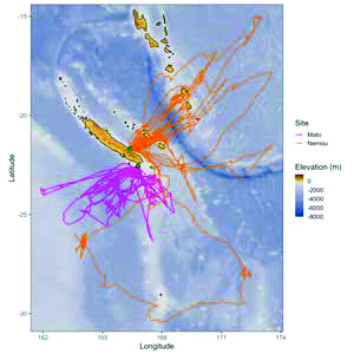
Figure 64. Foraging trips of GPS-tracked Tahiti Petrel from Îlet Nemou (orange tracks) and Mato (pink). The three islands close to New Caledonia north coast are the Loyalty Islands, the islands further north are part of the Vanuatu archipelago.
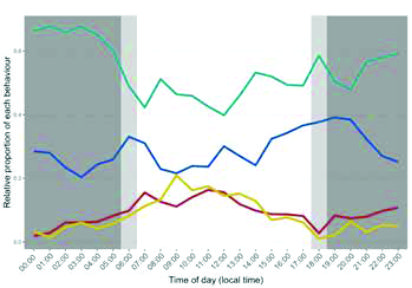

Figure 65. Percentage of time allocated to each behaviour by breeding Tahiti Petrels.
Collectively, these findings offer invaluable insights into the foraging behaviour of this elusive species. Gaining a deeper understanding of its at-sea distribution and foraging techniques will enable the identification of potential threats within New Caledonian and surrounding waters, which could direct conservation efforts for the species.