
3.5 Mark-recapture studies
Not advised for Palau at this point unless people are already experienced.
Seabirds should only be handled by people who have been properly trained.
Marking birds and then recapturing or resighting them later is a common method of estimating population size, as well as being a primary tool used to estimate survival and age structure in the population (See Section 5.4 Banding Schemes). Multiple visits are required to recapture birds and for survival studies these will be undertaken over multiple years (as many seabird species are long-lived, be prepared to be doing this for a long, long time!).
Mark recapture surveys require that large numbers of birds are ‘marked’, usually banded (or ringed) on the leg with metal identification bands; some larger species such as frigatebirds and boobies can be marked with wing tags. For shearwaters and petrels, a sub-set of monitored burrows can be utilised for mark-recapture studies. Both individuals of the pair are initially banded, and then the burrows visited annually (if possible) to recapture the birds. In this way longevity and survival rates can be calculated. For all of these studies, it is also valuable to obtain data on the sex of the species (for those that can’t be visually identified to sex, take feather or blood samples).

Figure 116. Banded New Zealand Storm-petrel, Hauraki Gulf. Captured and banded on Hauturu Little Barrier Island. Photo: Edin Whitehead.
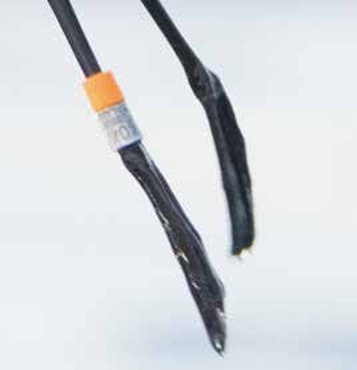
Figure 117. The same New Zealand Storm-petrel as above could be identified by colour metal band combination and numbers on the metal band. Photo: Edin Whitehead.