
1.8 Case study - Rapa, seabird restoration and the community
Tehani Withers, Island Restoration Project Manager, Société d’Ornithologie de Polynésie (SOP Manu)
Rapa Island in French Polynesia is a very important site for seabirds with 11 species present, mainly composed of petrels, shearwaters and storm-petrels. Three species breeding on its uninhabited motu (reo maohi for ‘islets’) are now in danger of extinction: the Rapa Shearwater (also known as Kākikāki) the Titan storm-petrel (a subspecies of White-bellied Storm-petrel) (Fregetta grallaria titan) and the Polynesian Storm-petrel – the latter two locally named Koru’e. These species are very rare and difficult to observe and are of important scientific interest. Indeed, it is suspected that the Rapa shearwater and the Titan storm-petrel breed nowhere
else in the world.
Rapa provides an ideal site for the protection of these species due to its large number of uninhabited motu, its remoteness and the diversity of seabird species present; however, like elsewhere in the Pacific, Rapa’s seabirds face a variety of threats. On the islands, invasive animals predate eggs, chicks and adult birds, and invasive plants encroach into and degrade breeding habitat. Therefore, the restoration of Rapa’s motu (Tauturou, Karapoo rahi and Rapa iti) - including the removal of invasive animals and plants - are considered essential by the Polynesian Ornithology Society (SOP) Manu and its partner, BirdLife International. Since 2017,
SOP Manu have helped the Rapa community to restore uninhabited islets for the protection of seabirds by removing goats. In 2023 a rat eradication project was also initiated, and the success of that project will be assessed in mid-2025.
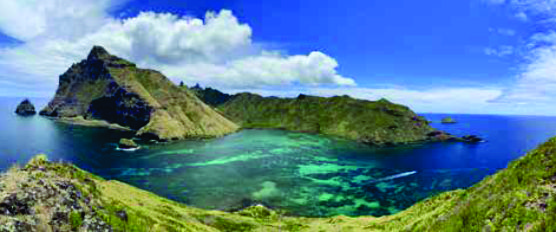
Figure 24. Looking towards the main island of Rapa from the summit of Tauturou. Photo: Tehani Withers, SOP Manu.
Another objective of the seabird restoration work on Rapa is to regularly monitor seabird populations. Monitoring began in 2020 with the help of Raumatariki, an environmental NGO on the island whose objective is biodiversity protection. This was mainly done through ground searches and the use of trail cameras. From this, it was found that Tauturou contains the largest colony of Murphy’s Petrel (Pterodroma ultima) in French Polynesia (approx. 2800 pairs). A significant decline in Kākikāki colonies was also detected, with a population estimate of less than 200 pairs. This population decline is likely due to the effects of invasive species,
but additional pressure is possible through changes in the marine environment surrounding Polynesia such as overfishing and pollution affecting prey species.
In order to discover what might be causing the decline in Kākikāki colonies, a team set out to determine where the birds travelled during December-February each year when they were away from the islands, and therefore what threats they might face at sea. In 2019, a team including Jean-Claude Thibault (ornithologist), members of SOP Manu and Raumatariki field workers attached lightweight GLS tracking devices to 10 Kākikāki to determine their migration routes. The following year, the team tried to recapture the birds to retrieve the devices but were only able to recapture one, as the birds were elusive and difficult to catch on land. Initial results from this device show the Kākikāki travelling south after tagging, and several locations have been recorded around the Pitcairn Islands, New Zealand and Chile.
Raumatariki, with the help of SOP Manu, work hard to preserve Rapa’s natural and cultural heritage with the help of local communities. For example, Raumatariki have helped to fence destructive ungulates (oxen, horses and goats) out of endemic forests so that the forests can recover from grazing. They also work with local students to teach them about the biodiversity on the island and why it must be protected by showing them the restoration projects organised by Raumatariki and SOP Manu. The students help to remove invasive grass to protect the koru’e colony at Tarakoi and have visited the petrel colony on Tauturou.
Future work to protect Rapa’s birds includes eradicating rats from more motu, controlling invasive strawberry guava on Tauturou and fencing more indigenous forest from ungulates. This project was funded in 2023 by Fond Vert (France) and will be carried out by trained local people and overseen by Tehani Withers & SOP Manu from Tahiti.
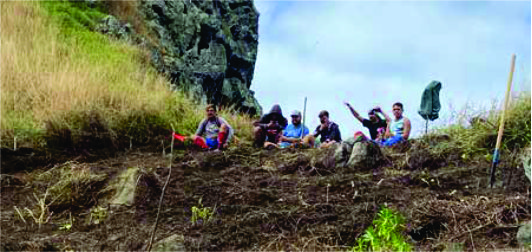
Figure 25. Tarakoi habitat restoration (removal of Melinis grass) with the local community of Rapa. Photo: SOP Manu.