
2.2.10 Case study - Who lives in the open sea?
Distribution and densities of surfacing marine megafauna, including seabirds through Remmoa aerial surveys in the South Pacific
Sophie Laran, Observatoire PELAGIS, La Rochelle Université – CNRS, France
The large dedicated aerial survey programme, Remmoa, was conducted in three different subregions of the South Pacific: New Caledonia (2014), Wallis and Futuna EEZ (2015), and French Polynesia (2010)71. The aim of these campaigns is to monitor marine megafauna (marine mammals, seabirds, turtles, rays, sharks, large fish, as well as marine litter and boats) in French overseas territories and adjacent waters, to identify their habitats and hotspots of density and diversity and reveal areas of ecological interest for marine megafauna. Following the West Indies and French Guiana and the Southwest Indian Ocean, these surveys were conducted using a standard line-transect methodology, and the same standardised multi-taxon protocol. Three high-winged aircraft (Britten Norman Islander) flew at 90 knots with a target altitude of 600 feet (183 m). Each flight typically consisted of two observers scanning the sea surface on either side of the aircraft with the naked eye to survey close to the track line through both bubble windows. Seabird sightings were collected in strip transect within 200m band each side. Observers attended a training course (including flights) to apply the standardised protocol, collect data using SAMMOA application, and identify taxa to the lowest taxonomic level possible.
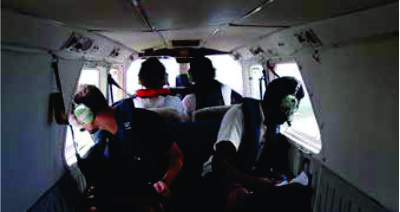
Figure 92. Aircraft interior with some of the survey team, viewing through observation bubbles either side. Photo:
Thomas Auger.
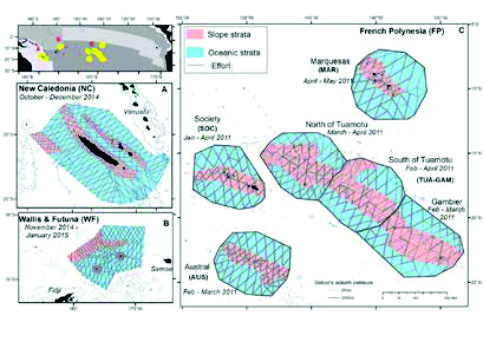
Figure 93. Survey effort for the REMMOA aerial surveys in the Tropical Pacific Ocean. (a) New Caledonia 2014, (b)
Wallis and Futuna EEZ 2015, and (c) French Polynesia 2010.
In the South Pacific more than 122,000 km of transects were analysed (2.5 million square kilometres). Of the 25,842 seabird sightings, 4,094 could be assigned to single species and 16,011 were identified at the genus level. For consistency, sightings were pooled into 11 different taxonomic groups as species identification could be difficult for terns: ‘brown’ terns, ‘grey’ terns, White terns, noddies, Hydrobatidae, ‘grey’ petrels, ‘brown’ petrels, shearwaters, Sulidae (boobies), Phaethontidae (tropicbirds), Fregatidae (frigatebirds).
Taxonomic diversity appeared to be broadly similar across subregions, while seabirds encounter rates showed contrasting patterns. Cumulative density of seabirds peaked in the north of French Polynesia and New Caledonia. The latter hosted the highest densities of shearwaters and ‘grey’ petrels. Conversely, noddies, White Terns, boobies and frigatebirds were most abundant in French Polynesia and tropicbirds stood out as the only stable group in all three subregions.
The analysis provided density estimates for a total of 22 different marine megafauna taxa including marine mammals, sea turtles, and elasmobranchs (sharks, rays and skates). For seabird data collected via strip transect methods, in the absence of an available and accepted methodology, we did not attempt a correction (as was carried out for marine mammals) and therefore our results should be considered as conservative estimates.
Identification from plane can be a bit limited as some species are difficult to identify. Stormpetrel species for example can’t be identified at species level but their fluttering flight is characteristic. Tropicbirds are easier to identify to species, with the white tail being easier to detect than the red one. Difficult groups remain the petrels and shearwaters, with only a few sightings identifying species available.
Nevertheless, this study provides the first comparison of marine species assemblages across the three oceanic subregions and establishes a regional baseline for the biogeography of marine megafauna in the region. The taxonomic and spatial extent of the results opens new perspectives for the development of local conservation measures, especially for taxa with already documented population declines.